Elisa Cappellari
PhD thesis title: Development and assessment of physics-based models for inert and chemically active fission product behaviour for Minor Actinide-bearing nuclear fuels.
Academic Tutor: Lelio Luzzi
Academic Supervisors: Davide Pizzocri
PhD cycle: 40° (see all student profiles of the same cycle > LINK)
BSc: Materials Engineering and Nanotechnology, Politecnico di Milano
MSc: Nuclear Engineering, Politecnico di Milano
Reactor institute, Delft University of Technology (TUDELFT), Delft, Netherlands (Done, March - July 2026); CEA-Cadarache, Saint-Paul-lez-Durance, France (Planned, September 2026 - January 2027)
Master's degree thesis award ``Giovanni Pastore``; Degree of the International School of Nuclear Law (ISNL).
Thesis abstract
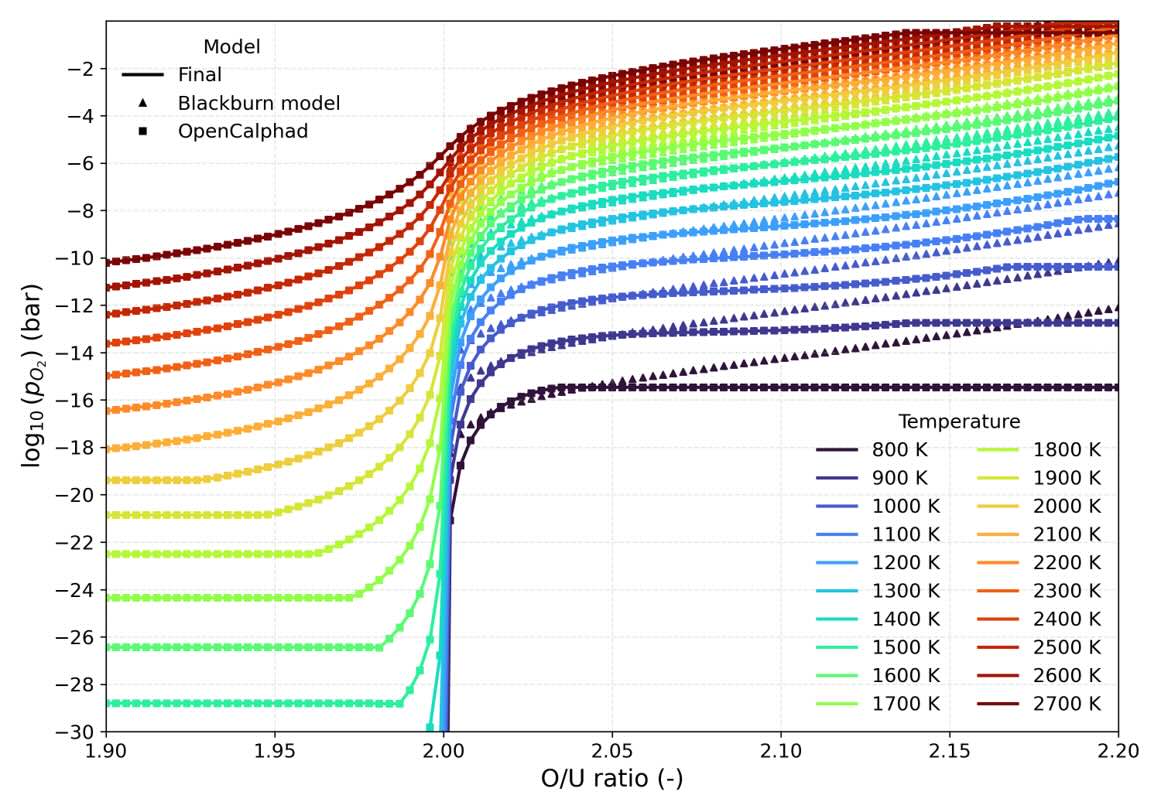
My PhD project aims to improve the accuracy of Fuel Performance Codes to support qualification of Minor Actinide-bearing fuels for Generation IV reactors. I focus on fission product behaviour and fuel chemical evolution, developing physics-based models along three routes: thermochemical evolution of the fuel, coupling SCIANTIX with CALPHAD-based tools (OpenCalphad); inert gas behaviour under transient and high-burnup conditions; and transport of volatile fission products in the fuel-cladding gap, including Joint-Oxide-Gaine formation. Models are implemented and validated in SCIANTIX and TRANSURANUS.
My PhD research project is relevant for the activities planned in the OperaHPC (https://cordis.europa.eu/project/id/101061453) and TRANSPARANT (https://cordis.europa.eu/project/id/101166386) Projects, directly involving the POLIMI Nuclear Reactors Group in Work Packages devoted to development, implementation, validation and uncertainty quantification of models used in European FPCs for nuclear fuel behaviour. I am also involved in the CONNECT-NM partnership (https://cordis.europa.eu/project/id/101165375) for the NEO4MAT Project (RL1)
My PhD research project is relevant for the activities planned in the OperaHPC (https://cordis.europa.eu/project/id/101061453) and TRANSPARANT (https://cordis.europa.eu/project/id/101166386) Projects, directly involving the POLIMI Nuclear Reactors Group in Work Packages devoted to development, implementation, validation and uncertainty quantification of models used in European FPCs for nuclear fuel behaviour. I am also involved in the CONNECT-NM partnership (https://cordis.europa.eu/project/id/101165375) for the NEO4MAT Project (RL1)
Personal interest in my research theme
I chose this topic because fuel performance codes rely heavily on correlation-based models, which limits their predictive power for advanced fuels under new operating conditions. I find it fascinating to bridge scales, from mesoscale mechanistic modelling of fission product behaviour to engineering-scale fuel-rod analysis, and disciplines, coupling thermochemistry with thermomechanics. Contributing to more predictive tools for Minor Actinide-bearing fuels behaviour is relevant to the safety and sustainability goals of Generation IV nuclear systems.