Oliver Kadi
PhD thesis title: Investigation of a supersonic turbine cascade under unsteady conditions
Academic Tutor: Giacomo Persico
Academic Supervisors: Paolo Gaetani and Noraiz Mushtaq
PhD cycle: 40° (see all student profiles of the same cycle > LINK)
BSc: Mechanical engineering, Chalmers University of Technology
MSc: Mechanical Engineering, Chalmers University of Technology
KTH - Stockholm: LES Simulations. Planned October 2026 - December 2026; VKI - Brussels: Subsonic turbine testing for RDE application: Planned March 2027 - May 2027; ENSMA - Pprime - Poitiers: Radial RDE and turbine testing: Planned October 2027-December 2027
Thesis abstract
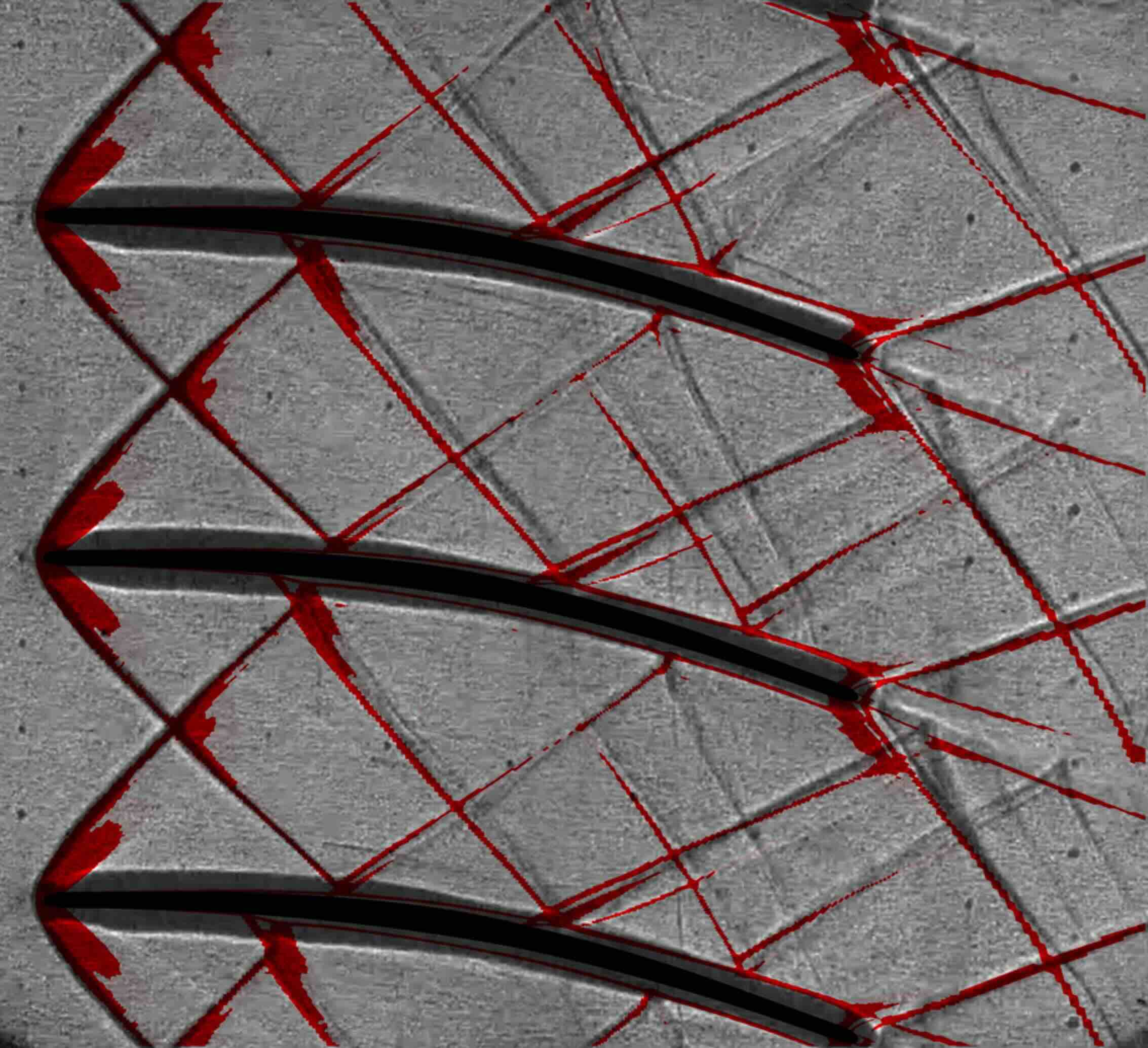
Rotating Detonation Engines (RDEs) promise higher thermodynamic efficiency than conventional combustors, but they deliver a strongly unsteady flow to the turbine downstream. The effect of these fluctuations on stator performance remains experimentally uncharacterised. The unsteady aerodynamics of supersonic turbine stator cascades subjected to fluctuating inlet conditions are studied in this research. A cold linear blow-down wind tunnel is commissioned to test the fully supersonic cascade, with purpose-designed unsteadiness generators installed upstream to impose inlet disturbances at prescribed frequencies and amplitudes, reproducing conditions representative of RDE operation. Inlet and outlet flow fields are characterised in both steady and unsteady regimes by means of slow and fast-response pressure probes and multi-hole probes, from which the aerodynamic performance parameters are derived. Schlieren visualisation is applied to qualify the shock pattern upstream of and within the blade channel. Unsteady CFD simulations are conducted to support the interpretation of the experimental findings. Aerodynamic loss is ultimately assessed as a function of the inlet disturbance frequency, quantifying the variation of performance associated with detonation-like inflow.
Personal interest in my research theme
What excites me most about this research is the opportunity to carry a design from an initial idea and defined boundary conditions through to experimental testing, subjecting it to a flow and observing how it actually behaves. Schlieren visualisation has been a particular focus of mine, including the development of post-processing methods that clearly reveal shock structures and make the underlying physics directly visible, rather than inferred. I also enjoy the continuous problem-solving involved in laboratory work, where experimental setups evolve constantly and no two days bring the same challenge. Ultimately, I am motivated by the opportunity to advance novel propulsion and power technologies and to help move promising concepts beyond simulation towards experimental demonstration.